
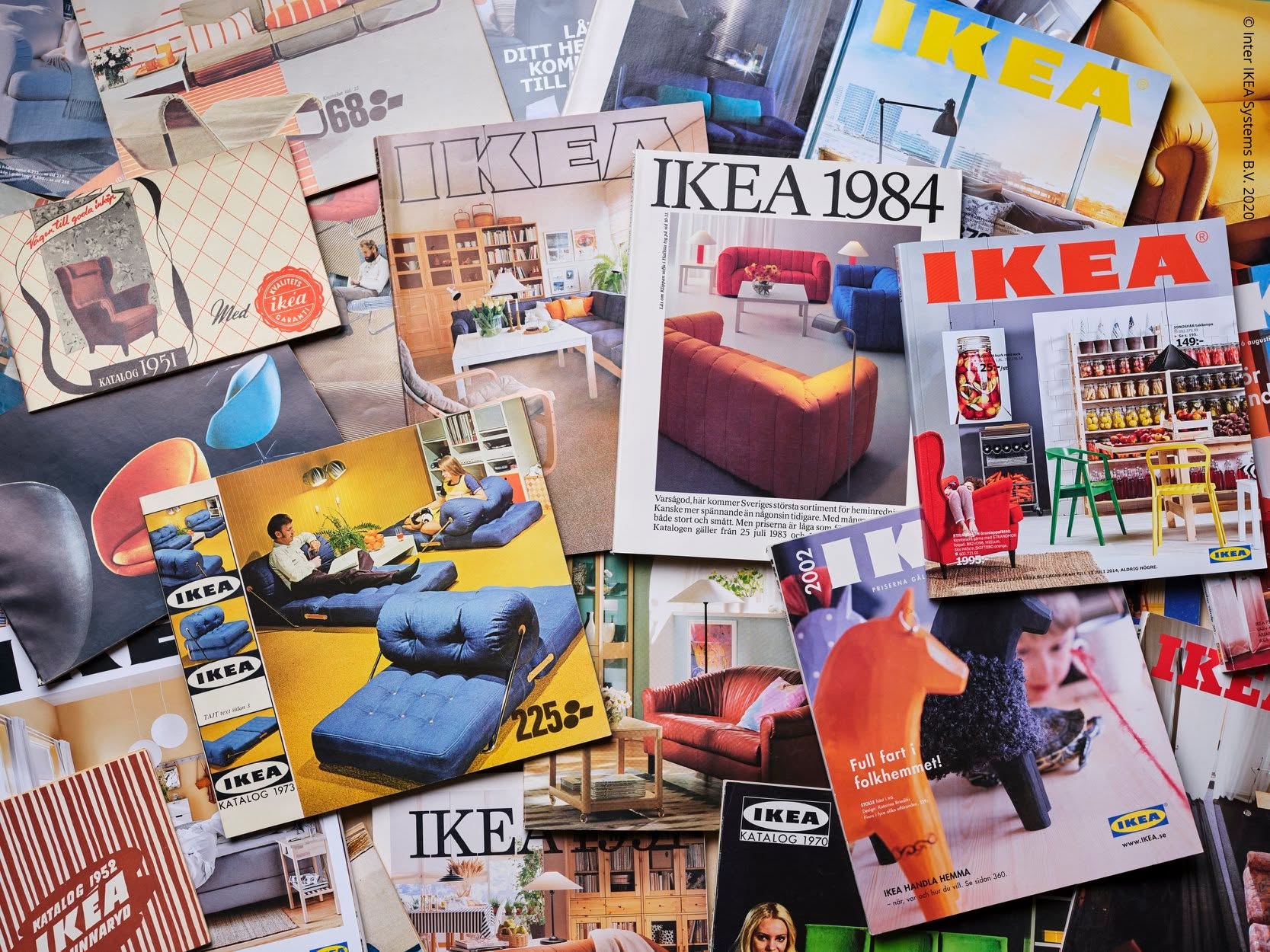
In 1951, a 25-year-old Swedish entrepreneur named Ingvar Kamprad put together the first IKEA Catalog. It was 68 pages, printed in Swedish, and distributed in 285,000 copies across southern Sweden.
There was no global retail empire behind it yet. The catalog was essentially a highly organized way to put IKEA’s products, prices, and ideas directly into customers’ hands.
That relatively modest booklet would eventually become one of the most recognizable pieces of retail marketing ever produced.
At its peak in 2016, IKEA distributed roughly 200 million catalogs in 69 different versions, translated into 32 languages and sent to more than 50 markets around the world.
For a furniture company, that kind of print scale is almost difficult to comprehend.
But the more interesting story isn’t simply how many catalogs IKEA printed. It’s why people actually wanted to look through them.
From price list to cultural object
The earliest IKEA catalogs were primarily functional: products, illustrations, descriptions, and prices.
Over time, IKEA realized the catalog could do something much more powerful than simply document inventory. It could help people imagine their homes differently.
Rather than showing a chair floating on a white background, IKEA increasingly showed that chair inside a complete room. A sofa wasn’t just a sofa. It was part of an apartment, a family room, a reading corner, or a particular way of living.
The catalog became a kind of rehearsal space for the customer. Long before someone visited an IKEA store, they could picture what their home might look like with IKEA products in it.
By the 1970s, the catalogs had become more colorful and lifestyle-driven. Over the following decades, photography, typography, room styling, and editorial storytelling became increasingly sophisticated.
Eventually, the catalog itself became something people anticipated.
IKEA quietly reinvented product photography
One of the more surprising chapters in the catalog’s history came much later.
By the 2000s, IKEA had begun experimenting heavily with computer-generated product imagery.
The company’s first fully computer-generated piece of furniture—a chair—appeared in 2006. The technology improved quickly, and by 2014, roughly three-quarters of IKEA’s product images were reportedly being generated digitally.
Most customers probably never noticed.
That was the point.
CGI allowed IKEA to create highly controlled room environments without having to manufacture, ship, assemble, stage, photograph, and dismantle every possible combination of products.
It was a technological solution serving a fundamentally traditional medium: the printed catalog.
Why the catalog worked as hard as it did
1. It was localized, not simply translated
IKEA didn’t treat every market exactly the same. Different editions could reflect local products, pricing, layouts, models, and cultural preferences. At its peak, IKEA was producing dozens of different versions of the catalog for markets around the world.
The lesson is simple: relevance matters. A printed piece created for the audience receiving it will almost always feel more valuable than something obviously designed for everyone.
2. It commanded a serious marketing budget
By the early 2000s, the IKEA catalog had become the centerpiece of the company’s marketing strategy, with reports estimating that it accounted for roughly 70% of IKEA’s annual marketing budget.
This wasn’t promotional material sitting on the sidelines of the campaign.
For years, the catalog was the campaign.
3. It lived in the customer’s home
A catalog on a coffee table behaves very differently from an ad on a screen.
It can be flipped through once, left sitting for a week, picked up again, folded open to a particular page, handed to someone else, or revisited before a purchase.
That persistence is one of print’s most overlooked advantages.
Digital advertising often competes for seconds of attention. A useful printed piece can remain in someone’s physical environment for days, weeks, or even months.
4. It made ordinary products aspirational
Flat-pack furniture isn’t inherently glamorous.
IKEA’s catalog gave those products context. A shelving unit became an organized home office. A dining table became a family dinner. A sofa became a cozy Saturday afternoon.
IKEA wasn’t simply selling furniture. It was showing customers the life the furniture might help create.
Why IKEA finally ended the catalog
In December 2020, IKEA announced that the 2021 edition would be the final IKEA Catalog after a 70-year run.
IKEA described the decision as both emotional and rational.
Customer behavior had changed dramatically. More people were researching and buying furniture online, fewer people were relying on the printed catalog, and IKEA’s digital channels had become enormous.
In the year before the announcement, IKEA reported that online retail sales had increased 45% worldwide and IKEA.com had received more than four billion visits.
At that point, continuing to produce and distribute a massive annual catalog no longer made the same strategic sense.
But there’s an important distinction.
IKEA didn’t prove that print stopped working.
It proved that marketing formats have to evolve alongside customer behavior.
A mass-distributed annual catalog made perfect sense for IKEA for decades. Eventually, digital discovery became better suited to the scale and frequency of the company’s global product assortment.
The principles that made the catalog successful, however, didn’t disappear with it.
What this means for your brand
You don’t need to print 200 million copies to borrow from IKEA’s playbook. The underlying lessons work at almost any scale.
- A catalog is a sales tool people can keep. Emails disappear down an inbox and ads vanish when someone scrolls away. A well-produced catalog, booklet, or lookbook can sit on a desk, counter, coffee table, or showroom shelf until someone is ready to act.
- Relevance beats reach. IKEA’s regional versions are a reminder that the best marketing doesn’t always try to speak to everyone. A piece built around the products, offers, locations, or needs of a specific audience can be far more effective than a generic version.
- Design for browsing, not just scanning. Print gives brands room to slow things down. Catalogs and booklets can create pacing, hierarchy, storytelling, and discovery across multiple pages.
- Give the reader somewhere to go next. Print doesn’t have to compete with digital. A catalog can drive someone to a store, sales representative, landing page, QR code, or online product page.
The printed piece earns attention. The digital destination makes the next step easy.
Catalogs can still earn attention
The IKEA Catalog didn’t remain relevant for 70 years by accident.
It worked because IKEA understood something fundamental about marketing: people respond differently to something they can hold, browse, revisit, and keep.
That hasn’t disappeared.
The opportunity today isn’t necessarily to recreate IKEA’s massive annual mailer. It’s to use print more intentionally.
A beautifully produced catalog, booklet, lookbook, direct-mail piece, or sales kit can create a slower and more memorable interaction with a brand—especially in a world where nearly every other marketing message arrives through a screen.
At Quixprint, we help brands produce catalogs, booklets, and marketing materials that turn products and ideas into something customers actually want to hold onto.
Have a catalog or booklet project in mind?
Tell us what you’re printing, and we’ll take care of the rest.
Request a quote →