
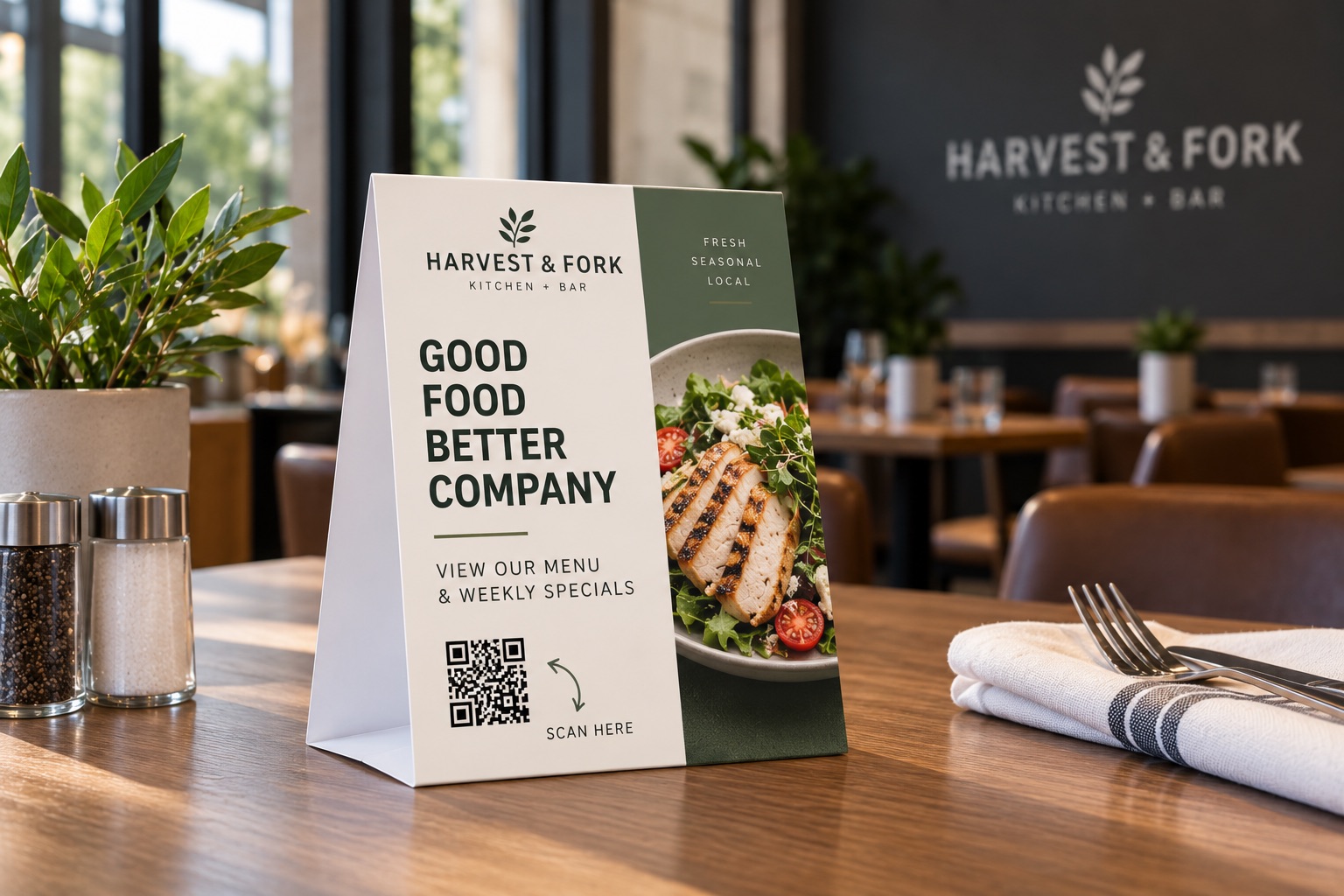
Walk into almost any restaurant, bar, or waiting room and you'll find the same thing: a flat, empty surface sitting directly in front of a captive audience, doing nothing.
That's advertising real estate going unused.
A table tent fills it. It's one of the cheapest, easiest tools in small-business marketing, and it's also one of the most overlooked — mostly because it seems too simple to matter.
But the format works precisely because it's simple.
Why a small card on a table still works
Digital ads compete for a few seconds of scroll time. A table tent doesn't compete with anything. It sits at eye level, right where a customer already has a few idle minutes — waiting for food, waiting for an appointment, waiting for a drink.
There's no swipe, no click, no algorithm deciding whether it gets seen. If someone sits down, they see it.
That's a rare kind of guaranteed attention.
Where table tents earn their keep
- Restaurants and bars — specials, happy hour times, events, loyalty programs
- Cafés — new menu items, Wi-Fi info, catering upsells
- Dental and medical offices — service reminders, financing options, review requests, referral incentives
- Salons and spas — retail promotions, membership packages, seasonal offers
- Corporate break rooms — internal announcements, event signage, wellness programs
Anywhere a customer sits and waits, there's a spot for one.
Standard sizes for custom table tent printing
Most print shops work with a handful of standard dimensions:
- 4" x 6" — the workhorse size, fits nearly any table without crowding it
- 5" x 7" — more room for text or a larger photo
- 3.5" x 5" — compact, built for bar tops and narrow counters
- Tri-fold / triangle — three visible panels, readable from any seat at the table
If you're printing multiple panels, give each one a single job. A tent trying to say five things at once ends up saying nothing.
What makes a table tent actually get read
1. One message, not five
Pick a single offer, promotion, or announcement per tent. If you've got more to say, rotate tents by week or table rather than cramming everything onto one card.
2. Design for a glance, not a close read
Nobody picks these up and studies them. They're read from across a table, at a distance, without much attention. A bold headline — at least 24–30pt — carries more weight than a paragraph of copy ever will.
3. Match your brand, not a template
Colors and type that match your existing signage or menu make the tent feel like part of the business, not a stray flyer someone left behind.
4. Give the QR code a reason to exist
“Scan for our full menu” works. A bare QR code with no context gets ignored — it's asking for effort without offering a reason.
5. Print it to survive the table
Table tents get knocked over, wiped near, and handled all day. Standard paper doesn't hold up. Cardstock — or a laminated finish for bars and restaurants — does.
6. Treat them like they expire
An offer that ended two months ago sitting on a table doesn't just fail to convert — it makes the business look inattentive. Set a recurring reminder to refresh them seasonally.
What this means for your business
You don't need a full print campaign to make this work. The same principles that apply to any print piece apply here, just at a smaller scale:
- A table tent is a sales tool that stays put. Unlike a post or an email, it doesn't disappear the moment someone looks away.
- Relevance beats volume. One well-targeted offer outperforms five competing ones.
- Give the reader somewhere to go next. A QR code, a phone number, or a simple call-to-action turns a glance into an action.
The tent earns the attention. The next step makes it worth something.
Small space, real return
Table tents aren't flashy, and that's part of why they get skipped. But for restaurants, bars, dental practices, and medical offices alike, they reach 100% of the people who sit down — no ad spend, no algorithm, nothing standing between the message and the customer.
At Quixprint, we produce custom table tents in standard sizes, cardstock and laminated finishes, helping businesses turn everyday table space into an effective marketing opportunity.
Have a table tent project in mind?
Tell us what you're printing, and we'll take care of the rest.
Request a quote →