
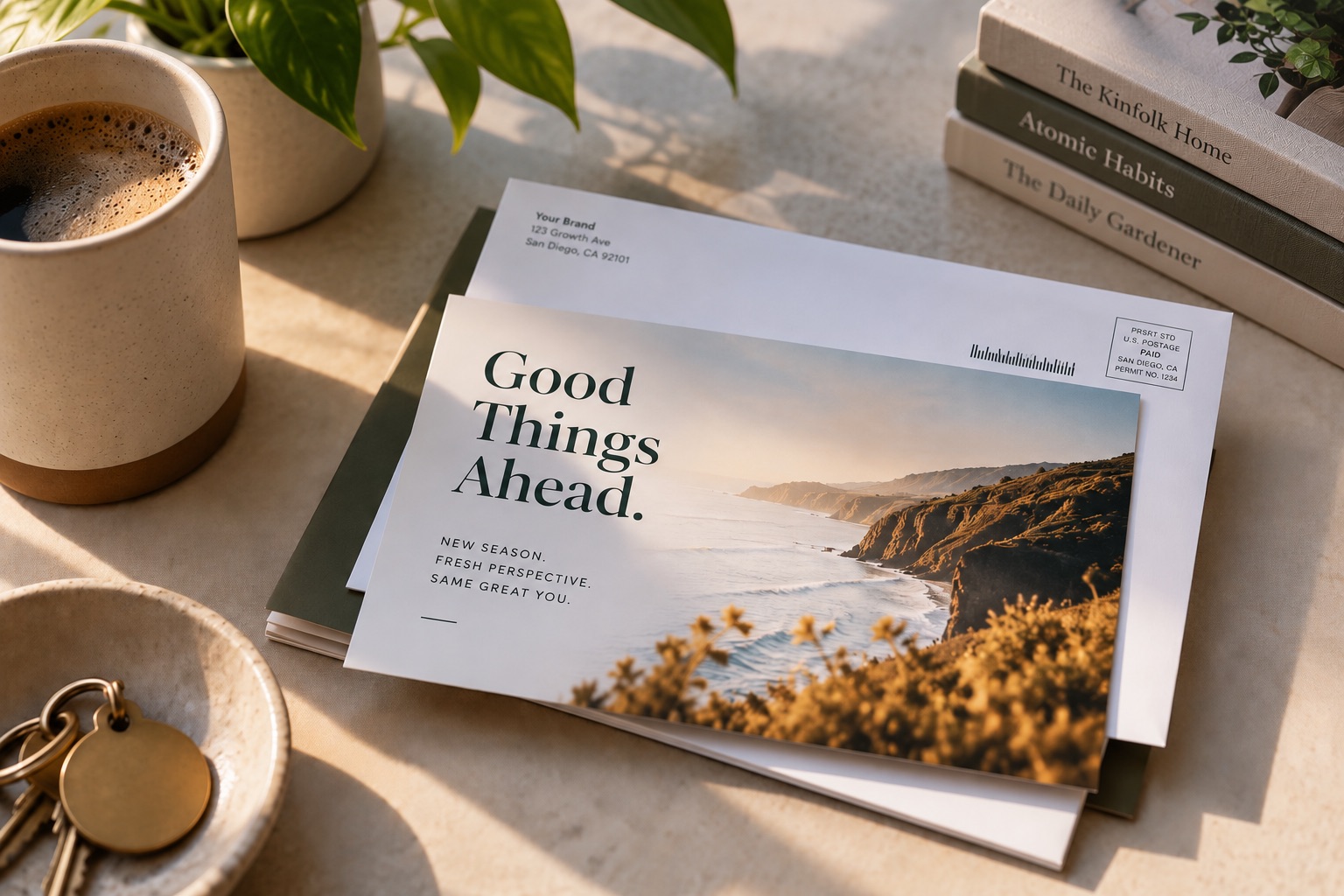
In a world dominated by email, social media, paid search, and digital advertising, direct mail might seem like an old-school marketing strategy.
The data tells a different story.
Direct mail continues to generate measurable engagement for businesses. As digital inboxes become increasingly crowded, a well-designed piece of printed mail gives brands something that is becoming harder to find online: attention.
For businesses looking to generate leads, reconnect with customers, promote an offer, or drive traffic online, direct mail marketing remains a powerful part of the marketing mix.
What is the average direct mail response rate?
There is no single universal direct mail response rate. Results vary significantly depending on the audience, offer, mailing list, creative, industry, and whether a campaign targets existing customers or new prospects.
Existing customers tend to respond at higher rates than cold prospects because they already have a relationship with the brand. That makes direct mail particularly useful for customer retention, reactivation, upselling, and repeat-purchase campaigns.
The takeaway is simple: targeted direct mail can generate meaningful, measurable action when the audience, offer, design, and format work together.
Why direct mail still works
Think about your email inbox.
Businesses are competing with newsletters, promotions, automated sequences, work emails, notifications, spam, and dozens of other messages every day.
Physical mail operates in a completely different environment.
A printed postcard, self-mailer, letter, catalog, brochure, or dimensional mail piece has to be physically handled. It occupies real space, can remain in a home or office, and can be revisited later.
That gives marketers multiple opportunities for a single printed piece to make an impression.
Direct mail can drive digital conversions
One of the biggest misconceptions about direct mail marketing is that businesses have to choose between print and digital.
Some of the most effective campaigns use both.
A direct mail piece can encourage someone to:
- Scan a QR code.
- Visit a landing page.
- Redeem a promotional code.
- Schedule an appointment.
- Request a quote.
- Visit a retail location.
- Call a sales representative.
- Make an online purchase.
In other words, the piece of paper in someone's mailbox can become the first step in a digital conversion.
Why direct mail gets attention
1. There is less competition in the mailbox
Digital advertising is everywhere. Consumers scroll past social ads, delete promotional emails, skip video ads, and ignore banners almost instinctively.
A physical mail piece has fewer messages competing for attention at the exact moment it is received.
2. Print is tangible
Direct mail gives marketers creative options that do not exist on a screen.
Paper stock, size, folds, coatings, die cuts, envelopes, variable data, finishes, and other production choices can all influence how the recipient experiences the campaign.
Instead of simply seeing an advertisement, the recipient can physically interact with it.
3. Direct mail can be highly targeted
Modern direct mail does not have to mean sending the same postcard to thousands of random addresses.
Businesses can build campaigns around customer lists, geographic areas, demographics, purchase history, customer segments, and other relevant data.
Variable data printing can take personalization even further by changing names, messaging, offers, imagery, or other elements from one recipient to another.
4. Print can have a longer lifespan
An email can disappear beneath dozens of new messages within hours.
A printed piece may stay on a desk, countertop, bulletin board, refrigerator, or in an office for days or weeks.
That extended lifespan gives brands additional opportunities to be remembered and acted upon.
Direct mail vs. email: which is better?
Email has significant advantages. It is fast, inexpensive to distribute, easy to automate, and highly measurable.
Direct mail offers different advantages.
The better question is not necessarily, "Should we use direct mail or email?"
It is: "How can direct mail and email work together?"
For example, a business could send a personalized direct mail piece introducing an offer, follow it with an email reminder, direct recipients to a dedicated landing page, and retarget visitors digitally afterward.
Each channel does a different job.
Print captures attention. Digital makes responding easy.
What makes a direct mail campaign successful?
Printing thousands of postcards and mailing them is not enough.
Successful direct mail campaigns typically depend on several factors working together.
- The audience: Who receives the mail may be the most important decision in the entire campaign.
- The offer: Give recipients a compelling reason to respond.
- The creative: Strong design should make the primary message and call to action immediately understandable.
- The format: A postcard, folded self-mailer, letter, brochure, catalog, or dimensional piece can each serve a different purpose.
- Personalization: Relevant messaging and variable data can make a campaign feel more intentional.
- The call to action: Tell recipients exactly what you want them to do next.
- Tracking: QR codes, unique URLs, promotional codes, dedicated phone numbers, or campaign-specific landing pages can help measure results.
Direct mail for B2B marketing
Direct mail is not just for consumer marketing. It can also be an effective B2B marketing strategy.
Companies can send targeted mail to specific businesses, locations, industries, or decision-makers.
For B2B marketers, direct mail can support:
- Lead generation campaigns.
- Account-based marketing.
- Sales prospecting.
- Product launches.
- Customer retention campaigns.
- Event and trade show promotion.
- Catalog distribution.
- Sample kits.
- New-location marketing.
- Re-engagement campaigns.
A thoughtful printed piece can also give a sales team a natural reason to follow up with a prospect after the mailer arrives.
Choosing the right direct mail format
The best format depends on what you are trying to accomplish.
Postcards are cost-effective and immediately visible.
Self-mailers provide more room for information while keeping the piece compact.
Letters and envelopes can work well for personalized or information-heavy campaigns.
Brochures are useful when a product or service requires additional explanation.
Catalogs allow brands to showcase a larger product assortment and can remain useful long after delivery.
Dimensional mailers and custom packages can create a premium experience for high-value prospects.
The cheapest piece is not always the piece that produces the best return.
How to improve direct mail response rates
If you are planning a direct mail campaign, focus on relevance before volume.
Start with a clean, targeted mailing list. Develop a clear offer. Make the primary message easy to understand within seconds. Give recipients one obvious next step.
Then test.
Businesses can experiment with different headlines, offers, formats, designs, calls to action, and audience segments to determine what produces the strongest response.
Direct mail becomes particularly powerful when it is treated as a measurable marketing channel rather than simply a printing project.
Is direct mail worth it in 2026?
For many businesses, yes.
Digital marketing is not going anywhere — and neither is print.
Physical mail can capture attention and create a memorable brand interaction, while QR codes, landing pages, online ordering, and digital tracking make it easier than ever to connect that physical interaction to measurable online behavior.
For marketing managers trying to break through crowded digital channels, direct mail offers something increasingly valuable: a different way to get noticed.
Direct mail printing and mailing services
At Quixprint, we help businesses produce high-quality direct mail campaigns, postcards, self-mailers, brochures, catalogs, marketing collateral, and other commercial printing projects.
Whether you are planning a targeted local mailing or a high-volume national campaign, our team can help determine the right print specifications, format, finishing, and production approach for your project.
Planning a direct mail campaign?
Tell us what you're mailing, and we'll help bring the campaign to life.
Request a quote →