
You've got the content, the layout, and the page count. Now there's one more decision before you order: how will it be bound?
For most catalogs and booklets, the choice comes down to perfect binding vs. saddle stitch. They look different, feel different, and suit different projects. Here's how to choose with confidence.
What is saddle stitch binding?
Saddle stitching uses metal staples through the fold. Printed sheets are folded, nested together, and secured along the center, usually with two staples.
- Spine: A folded edge, without a flat printable spine.
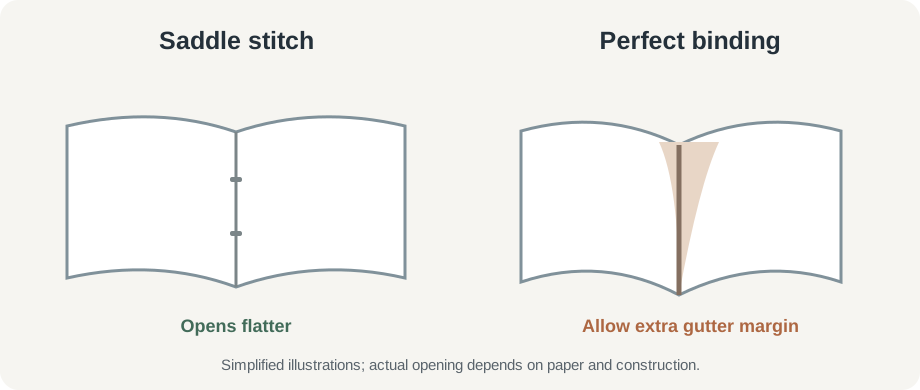
- Opening: Generally opens flatter than a glued book.
- Best for: Event programs, newsletters, short catalogs, lookbooks, and promotional booklets.
What is perfect binding?
Perfect binding uses adhesive to secure a stack of pages to a wraparound cover, creating a squared-off spine similar to a paperback.
- Spine: Flat and potentially printable, if the spine is wide enough for legible text.
- Opening: Pages curve toward the glued spine, so inside margins matter.
- Best for: Thicker catalogs, annual reports, directories, portfolios, and reference publications.
Perfect binding vs. saddle stitch: the key differences
1. Page count
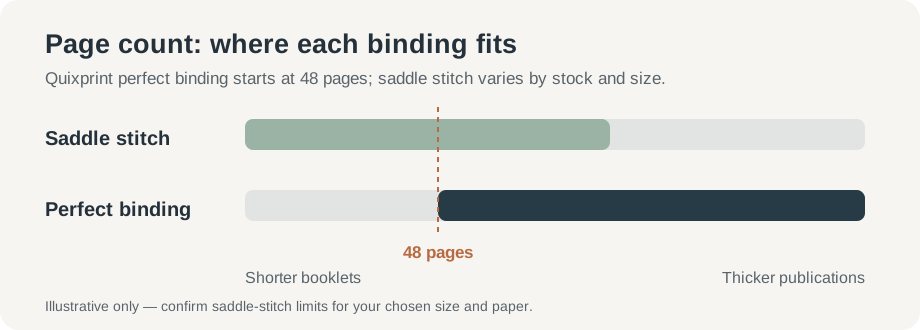
Page count is often the first deciding factor. Saddle stitch works well for shorter booklets, but thick nested sheets can cause bulging and page creep. The maximum depends on the finished size and paper weight; we'll confirm what's possible for your project.
For Quixprint's booklets and catalogs, perfect binding starts at 48 pages. Exact specifications depend on the selected product configuration. Booklet page counts are typically planned in multiples of four; confirm whether your chosen configuration includes the cover in the stated count.
2. Cost
Saddle stitching is usually more economical for shorter booklets because the finishing process is simpler. Perfect binding involves additional spine preparation, adhesive, and cover finishing, which can increase cost. The difference depends on quantity, paper, and specifications, so compare quotes when both methods are viable.
3. Durability
Both methods can hold up well when properly produced. Saddle stitching is a practical choice for promotional pieces and short publications. Perfect binding can provide a substantial, shelf-ready feel, but durability also depends on adhesive, paper grain, handling, and construction—not just binding type.
4. Look and feel
Saddle-stitched booklets have the familiar folded, stapled appearance. Perfect-bound catalogs have a squared spine and a paperback-style finish. A spine title may be possible on a perfect-bound piece, but only when the calculated spine width allows it.
5. How the pages open
Saddle-stitched pieces typically open flatter, making them useful for two-page spreads. Perfect-bound books resist opening fully flat; keep text and essential artwork away from the inside gutter.
Decision table: which binding is right for you?
| Consideration | Saddle stitch | Perfect binding |
|---|---|---|
| Page count | Shorter booklets; maximum depends on paper and size | Starts at 48 pages for Quixprint's booklet/catalog configuration |
| Typical cost | Generally lower | Generally higher |
| Production time | Often simpler finishing | Additional binding and finishing steps |
| Spine | Folded edge with staples | Square spine; text if sufficiently wide |
| Opening | Typically opens flatter | Needs additional gutter allowance |
| Best for | Programs, newsletters, short catalogs | Thicker catalogs, portfolios, reports |
| Appearance | Classic booklet | Paperback-style publication |
These are general comparisons, not a substitute for the exact specifications of your chosen size, stock, and quantity.
Quick ways to decide
Choose saddle stitch if:
- Your booklet is relatively short.
- You're distributing it in volume or mailing it.
- Cost and a straightforward finish are priorities.
- You want pages that open relatively flat.
Choose perfect binding if:
- Your project meets the 48-page minimum and applicable production requirements.
- You want a substantial, square-spined catalog.
- The publication will be shelved or kept for reference.
- You have room in the design for a proper inside gutter.
In the overlap? If both are available for your specifications, think about how the piece will be used and request pricing for each option.
Cover options: self cover vs. plus cover
- Self cover: Cover and inside pages use the same stock. Common for simple saddle-stitched booklets.
- Plus cover: A separate, often heavier cover stock gives the publication a more substantial feel. Availability depends on the binding and selected product options.
For a specific quote, we'll confirm the cover construction available with your chosen binding.
Design tips for each binding type
For saddle stitch
- Allow for creep. Nested sheets can shift the inner pages outward; leave comfortable trim margins.
- Plan pages in multiples of four. Verify the final page count and cover setup.
- Don't plan spine text. A folded edge isn't a printable square spine.
For perfect binding
- Protect the gutter. Keep important text and imagery clear of the glued edge.
- Confirm spine width. It depends on the stock and final page count—don't guess.
- Set up the cover correctly. Follow the approved template for back cover, spine, front cover, and bleed.
For both methods, review our guide on how to prepare files for printing before submitting artwork.
What this means for your business
- Match binding to the purpose. A short-lived handout and a long-term reference catalog have different needs.
- Consider distribution. Mailing weight, shelving, and frequent handling can affect the choice.
- Let page count guide the shortlist. Confirm eligibility before designing the cover.
- Compare real specifications. Price both options when your project qualifies.
Not sure which binding fits your project?
Neither method is universally better. Start with your page count, paper, finished size, and how customers will use the piece. At Quixprint, we can help you evaluate the options available for your booklets and catalogs and confirm the production specifications before you finalize artwork.
Ready to start your booklet or catalog?
Send us your page count, finished size, quantity, and intended use, and we'll help you choose an appropriate binding.
Get in touch